
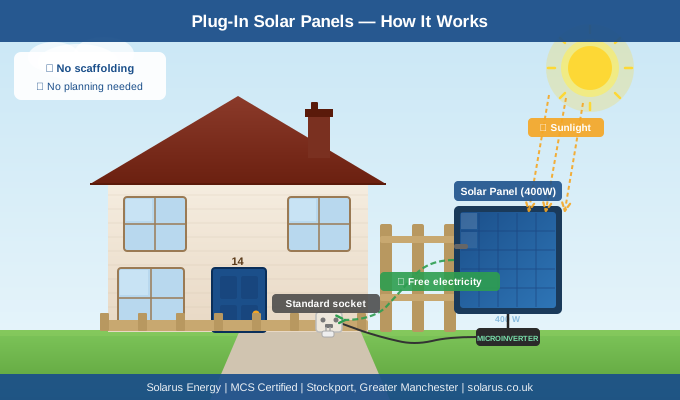
Something big is happening in the world of solar energy and it doesn’t require scaffolding, planning permission, or a five-figure investment. Plug-in solar panels are coming to the UK. On 24 March 2026, Energy Secretary Ed Miliband officially announced that these compact, low-cost solar systems would be available in UK shops “within months” – part of the government’s wider Clean Power 2030 Action Plan.
At Solarus in Stockport, we’ve been watching this space closely. As your local MCS Certified solar installer covering Stockport, Greater Manchester, Tameside, and Cheshire, we want to give you a complete, honest picture – what plug-in solar is, how it works, who it suits, and crucially, when a full rooftop system is still the smarter choice.
What Are Plug-In Solar Panels?
Plug-in solar panels, also known as balcony solar or plug-and-play solar are small, self-contained solar systems designed to generate electricity without the complexity of a full rooftop installation.
A typical kit includes:
- One or two solar panels (usually 400W each, up to 800W total)
- A microinverter — converts the panels’ DC electricity into AC electricity your home can use
- Mounting hardware — brackets for balcony railings, garden fences, or flat roofs
- A cable and plug that connects to a standard domestic socket
Once connected, the system feeds solar electricity directly into your home’s circuit. Your appliances automatically draw from solar first, reducing how much you pull from the grid. Your meter slows down. Your bill drops.
| Which? describes these as low-cost, portable solar panels that can be used on balconies or outdoor spaces to help reduce the amount of grid electricity you need to buy to power your appliances. Read the full Which? guide at which.co.uk |
Is It Legal in the UK? What’s Happening Right Now
This is where things get slightly nuanced, so let’s be precise.
The short answer: yes, plug-in solar is now officially legalised in the UK, but full self-installation without an electrician isn’t quite here yet.
Here’s the timeline:
| Date | What happened |
| 24 March 2026 | Government announces plug-in solar will be in UK shops “within months” |
| 15 April 2026 | BS 7671 Amendment 4 published – updated wiring regulations now in force |
| July 2026 (estimated) | BSI publishes the UK product standard – certified DIY kits can now be legally sold |
| Summer/Autumn 2026 | BSI-certified kits expected on shelves at Lidl, Amazon, and specialist retailers |
| October 2026 | BS 7671 transition period ends – all new electrical work must comply |
BS 7671 governs how electrical installations are wired and connected – that standard is now live. The BSI product standard certifies that specific manufactured kits meet UK safety requirements – that standard is expected in July 2026.
What this means in practice: You can buy plug-in solar kits right now (brands like EcoFlow STREAM are already available from around £499), but the fully compliant DIY self-installation route requires the BSI product standard to be published first. Until then, the safe and compliant route is installation by a qualified electrician, typically £250–£450 on top of the kit, with the same savings either way.
| Solarus note: If you want to start generating solar electricity from a balcony or garden space right now without waiting for BSI certification, we can install a compact system via a hardwired dedicated circuit – fully compliant under current regulations. Call us on 0161 674 0390. |
How Does a Plug-In Solar Panel Actually Work?
The technology is straightforward once you understand the key components.
1. The solar panels
Monocrystalline panels convert sunlight into direct current (DC) electricity. The same technology as rooftop solar, just smaller. A typical 400W panel measures around 1.8 x 1.2 metres and weighs around 20kg.
2. The microinverter
This is the clever bit. The microinverter clips onto the cable between the panel and the plug. It converts DC electricity into AC electricity at 230V – the same type your home uses and includes critical safety features including anti-islanding protection, which automatically shuts the system down during a power cut to protect anyone working on the lines.
3. The plug
The plug connects to a standard 13A domestic socket. The electricity flows into your home’s ring main circuit and is immediately consumed by whatever appliances are running – fridge, router, TV, kettle.
4. The meter
Your smart meter simply records less imported electricity. You’re not feeding back to the grid in any meaningful way at 800W, you’re just reducing your draw from it during daylight hours.
How Much Can You Save?
Let’s be honest here, plug-in solar is not going to eliminate your electricity bill. It will reduce it, particularly during daylight hours.
Here’s what a typical 800W system in the Greater Manchester area can generate:
| Setup | Annual generation (estimate) | Annual saving at 24p/kWh |
| 800W south-facing, optimal tilt | 600–750 kWh | ~£145–£180/year |
| 800W south-facing, balcony vertical | 430–530 kWh | ~£103–£127/year |
| 800W east/west facing | 400–500 kWh | ~£96–£120/year |
| 400W single panel, south-facing | 300–380 kWh | ~£72–£91/year |
*Estimates based on Greater Manchester solar irradiance data. Actual savings depend on panel placement, angle, shading, and daytime electricity usage.
The UK government estimates annual savings of £70–£110 for a standard 800W system. At Solarus, we think well-placed systems in the North West can exceed this, particularly south-facing setups with a good tilt angle.
The base load strategy: Plug-in solar works best when it covers your always-on appliances during the day. Your fridge, Wi-Fi router, smart TV on standby, phone chargers, and devices left plugged in collectively draw 200–400W continuously. A well-placed plug-in system can effectively eliminate this base load cost during daylight hours.
Payback period: A quality 800W kit costs £500–£1,000. With savings of £100–£180/year, you’re looking at a 3–6 year payback – considerably faster than a full rooftop system for someone who can’t install one any other way.
Who Is Plug-In Solar Best For?
This is the most important question – and we’ll give you a straight answer.
Plug-in solar is a great fit if you:
- Rent your home – Under the Renters’ Rights Act 2025, landlords cannot unreasonably refuse a plug-in solar installation. You can take the panels with you when you move
- Live in a flat with a balcony – This is the primary use case. Even a small south-facing balcony can generate meaningful electricity
- Have a garden, shed roof, or south-facing fence – Ground-mounted or fence-mounted panels are another option for homes without suitable roof access
- Want to try solar at low cost – £500 is a much lower commitment than a £7,000–£12,000 rooftop system
- Can’t get traditional rooftop solar – Listed building, conservation area, shared ownership, or simply an unsuitable roof
Plug-in solar is less ideal if you:
- Own your home and have a suitable roof – A properly installed rooftop solar and battery system will generate 5–10x more electricity, earn SEG export payments, and add value to your property
- Use a lot of electricity in the evening – Plug-in solar only generates during daylight hours. Without a battery, evening usage isn’t covered
- Have an older consumer unit – Some older homes have wiring or RCDs not designed for bidirectional power flow. A qualified electrician should check before installation
| Solarus view: If you own your home in Stockport or Greater Manchester and have a south-facing roof, a full rooftop solar PV system with battery storage will almost always deliver better long-term value. Plug-in solar is brilliant for the millions of households who can’t go that route. |
| Which? recommends getting your electrical circuit checked by an electrician to ensure it is safe and suitable for plug-in panels if you own your home. Read the Which? comparison of plug-in vs rooftop solar at which.co.uk |
What Are the Benefits of Plug-In Solar?
Lower energy bills
Even modest generation of 500–700 kWh per year can meaningfully reduce your electricity costs at a time when bills remain stubbornly high.
No planning permission required
No planning permission is required for kits that aren’t permanently fixed to the building. Balcony railing clamps and ground frames require no permission. Listed buildings and conservation areas may have additional rules – check with your local authority.
Portable — it moves with you
Unlike rooftop solar, you can take your plug-in system with you when you move. For renters, this is a significant advantage.
Clean, renewable energy
Every kWh your plug-in system generates is one fewer you draw from the grid – reducing your carbon footprint and supporting the UK’s transition to clean power.
Simple technology
The microinverter handles everything automatically. No app required. No complicated setup. It generates when the sun shines and stops when it doesn’t.
Low entry cost
At £300–£1,000 for a full kit, plug-in solar has by far the lowest barrier to entry of any home renewable technology.
Pairs well with battery storage
Several manufacturers now offer plug-in solar kits with an integrated battery. This stores daytime generation for use in the evening – significantly increasing self-consumption and savings.
What Are the Limitations?
Limited output
The 800W cap means this technology supplements your electricity – it doesn’t replace it. A full rooftop system can generate 3,500–6,000+ kWh per year. An 800W plug-in system generates 500–750 kWh.
No export payments (yet)
Under current regulations, plug-in systems are too small to register for the Smart Export Guarantee (SEG) in the traditional sense. You consume the electricity you generate rather than exporting it.
Daylight hours only (without a battery)
No sun = no generation. Without a battery, evenings, nights, and overcast days mean you’re back on grid electricity.
Safety considerations for older homes
The IET has warned that some older homes may have wiring or protection devices that were never designed for electricity flowing back into a circuit. In particular, older RCDs may not trip properly with plug-in generation. This is exactly why the BSI product standard and a professional check of your consumer unit matters.
BSI certification still pending
Until the UK BSI product standard is published (expected July 2026), no kit has been formally certified for DIY self-connection in the UK. European CE marks and German VDE certification do not automatically transfer post-Brexit.
Plug-In Solar vs Rooftop Solar: Which Is Right for You?
| Plug-In Solar | Rooftop Solar + Battery | |
| Upfront cost | £300–£1,000 | £7,000–£14,000 |
| Annual generation | 500–750 kWh | 3,500–6,000+ kWh |
| Annual saving | £70–£180 | £600–£1,400+ |
| Payback period | 3–6 years | 7–12 years |
| Export payments (SEG) | No (currently) | Yes |
| Planning permission | No | Usually no |
| Adds value to property | No | Yes |
| Suitable for renters | Yes | No |
| Suitable for flats | Yes | Rarely |
| MCS certification needed | No | Yes |
| Portable | Yes | No |
| Which? notes that rooftop solar PV systems have higher upfront costs but generate significantly more energy for your home — making them the better choice for homeowners with a suitable roof. See the full Which? comparison at which.co.uk |
What to Look For When Buying
When BSI-certified kits arrive in shops, here’s what Solarus recommends checking:
- BSI certification first – Only buy kits that carry the new UK BSI product standard certification. European CE marks alone are not sufficient for the UK market post-Brexit
- Microinverter quality – Established brands like Hoymiles and Enphase are considered the most reliable. EcoFlow’s STREAM microinverter has a strong track record across Europe
- Anti-islanding protection – This is non-negotiable. The microinverter must automatically shut down during a power cut. All certified kits will include this
- G98 notification – You’ll need to notify your Distribution Network Operator. For Stockport and Greater Manchester, your DNO is Electricity North West
- Consumer unit compatibility – If your home was built before the 1980s, have it checked by a qualified electrician before connecting any generating equipment
Plug-In Solar and the Bigger Picture
Plug-in solar is genuinely exciting – not because it replaces rooftop solar, but because it opens clean energy to millions of households who couldn’t access it before.
Germany already has over 1.15 million plug-in solar systems installed. The UK is now following that path.
For Greater Manchester and Stockport, where a significant proportion of residents rent or live in flats, plug-in solar could meaningfully reduce energy costs across the region without requiring any structural changes to properties.
As the technology matures, manufacturers are already developing hybrid systems that combine plug-in simplicity with battery storage – allowing households to store daytime generation for evening use. For more on how battery storage changes the economics of solar, see our battery storage guide at solarus.co.uk.
Solar Installation in Stockport and Greater Manchester
At Solarus, we install solar PV systems, battery storage, air source heat pumps, and EV chargers across Stockport, Greater Manchester, Tameside, Derbyshire and Cheshire. Whether you’re curious about plug-in solar, ready for a full rooftop installation, or want to understand which option suits your home and budget – our team is here to help with honest, no-pressure advice.
We are proud to hold the following accreditations:
- MCS Certified — solar PV, battery storage, and heat pumps
- NICEIC Approved — electrical installation
- Which? Trusted Trader — independently vetted and verified
- Octopus Trusted Partner
- CHAS
As a Which? Trusted Trader, we’re independently vetted and assessed so you can book with confidence. Which? has also published its own guide to plug-in solar at which.co.uk and a rooftop vs plug-in comparison at which.co.uk — worth reading alongside this guide.
| Ready to explore your solar options? 📞 0161 674 0390 📧 hello@solarus.co.uk 🌐 solarus.co.uk 📍 Unit 12 The Gate Centre, Bredbury Parkway, Stockport, SK6 2SN |
Official Resources & Further Reading
- GOV.UK: Plug-in solar announcement (March 2026)
- GOV.UK: Clean Power 2030 Action Plan
- Which?: Plug-in solar to become legal in the UK
- Which?: Plug-in vs rooftop solar — what’s the difference?
- Which?: Solar panel buying advice
- Ofgem: Smart Export Guarantee (SEG)
- MCS: Find a certified installer
- IET: BS 7671 Wiring Regulations (Amendment 4)
- Electricity North West: G98 connections (Greater Manchester DNO)
- Renters’ Rights Act 2025 guidance
- Energy Saving Trust: Solar panels